Settlement Timelines Shaping Accumulator Modifications in Live Soccer and Horse Racing Markets
Jakob Weber · Jun 25, 2026

Settlement Timelines Shaping Accumulator Modifications in Live Soccer and Horse Racing Markets
Transaction timelines in digital betting platforms determine how quickly stakes register and influence live accumulator structures during intense periods in soccer matches and horse races. Data from major operators indicates that delays ranging from 0.5 to 3 seconds can shift odds calculations for multi-leg bets, especially when markets update rapidly after goals or race position changes.
Core Mechanics of Live Accumulators
Accumulators combine multiple selections into single wagers where each outcome multiplies potential returns, and live versions adjust automatically as events unfold. In soccer, a sudden goal alters remaining legs while equine markets react to pace shifts near the finish line. Observers note that processing speed governs whether an accumulator locks in pre-update prices or incorporates revised figures, and studies from the University of Nevada Gaming Research Center show average adjustment windows of 1.8 seconds during peak volumes.
Peak moments coincide with high transaction influxes, such as stoppage time in league fixtures or the final 400 meters of group races. When multiple users submit bets simultaneously, server queues extend settlement intervals and operators apply dynamic margin controls to manage exposure.
Transaction Processing in High-Volume Scenarios
Payment gateways handle authorization, risk checks, and ledger updates in sequence before confirming bet placement. Research from the Singapore Gambling Regulatory Authority reveals that network latency spikes of 40 percent occur during concurrent global events, directly extending the window between bet submission and market refresh. Accumulators suffer most because each leg requires synchronized price validation across connected markets.
Platforms employ edge computing nodes to compress these intervals yet residual delays persist when traffic exceeds baseline capacity by 300 percent. June 2026 tournaments illustrate the pattern clearly as overlapping international fixtures and major racing festivals generate simultaneous demand spikes across time zones.
Comparative Effects Across Soccer and Equine Markets
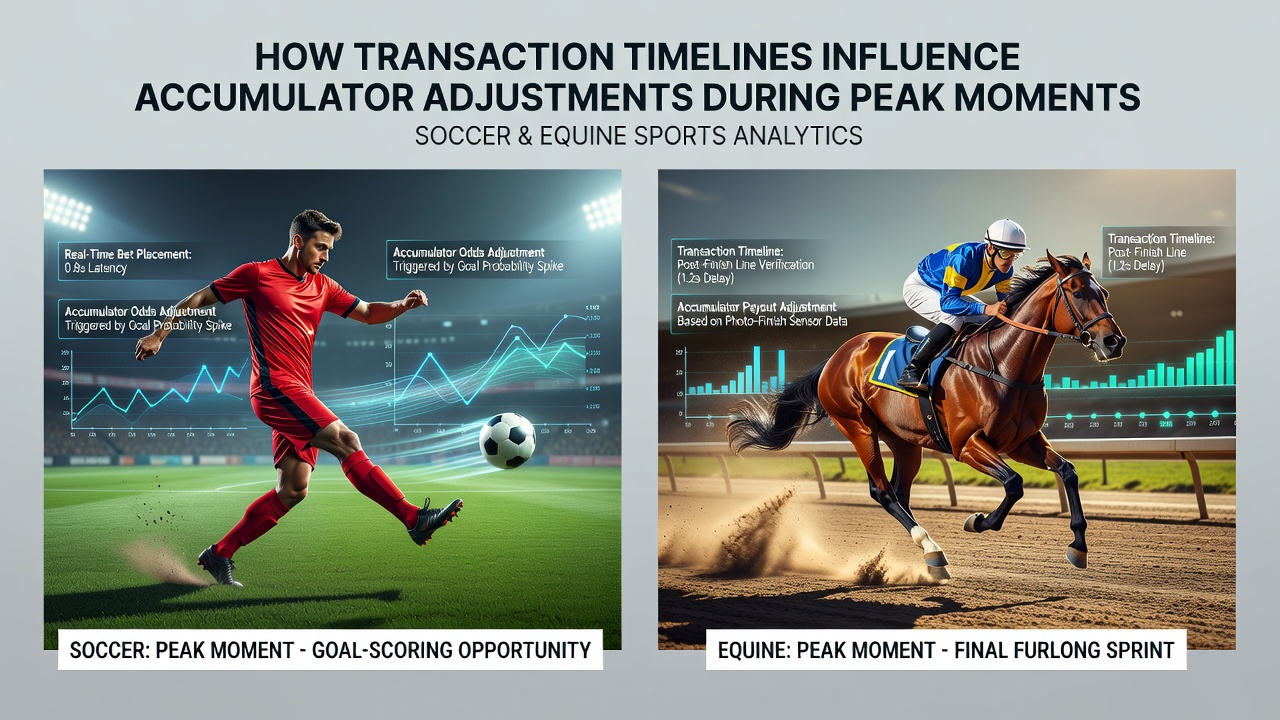
Soccer live markets update on discrete events such as substitutions or cards, creating brief windows for accumulator recalibration, whereas equine markets evolve continuously through speed ratings and sectional data feeds. Analysts at the Canadian Centre for Gaming Research found that soccer accumulators experience 12 percent more price drift during transaction lags than horse racing equivalents because discrete triggers cluster bets into tighter timeframes.
Equine platforms often pre-calculate multiple contingency lines for each runner, allowing partial accumulator updates even amid brief processing pauses. Soccer systems rely more heavily on real-time goal and possession metrics, leaving less buffer when settlement queues lengthen.
Operator Adjustments and Risk Protocols
Bookmakers deploy automated throttles that suspend new accumulator entries once transaction backlogs exceed internal thresholds. Figures released by the European Betting and Gaming Association indicate that suspension periods averaged 4.2 seconds during June 2026 peak windows, after which accumulators resume with recalibrated coefficients.
These protocols protect against adverse selection yet create temporary market gaps that sophisticated users monitor through multiple interfaces. Data pipelines from third-party odds providers feed into central engines, and any mismatch between gateway confirmation times and feed latency triggers manual overrides in extreme cases.
Technological Mitigations and Future Developments
Distributed ledger experiments and 5G edge routing appear in several pilot programs aimed at trimming authorization sequences below 200 milliseconds. Industry reports from the Australian Institute of Gambling Research document test reductions of 35 percent in accumulator drift rates under simulated peak loads when these technologies combine with predictive caching of common bet structures.
Operators continue refining queue management algorithms that prioritize accumulator submissions containing legs from both soccer and equine markets, recognizing that cross-sport combinations generate higher margins yet carry elevated timing sensitivity.
Conclusion
Transaction timelines remain a decisive factor in accumulator behavior during live soccer and equine peaks, shaping both user outcomes and operator risk frameworks. Continued infrastructure investments alongside regulatory data collection from diverse jurisdictions will determine how precisely platforms can align settlement speeds with the rapid pace of in-play market movements.